


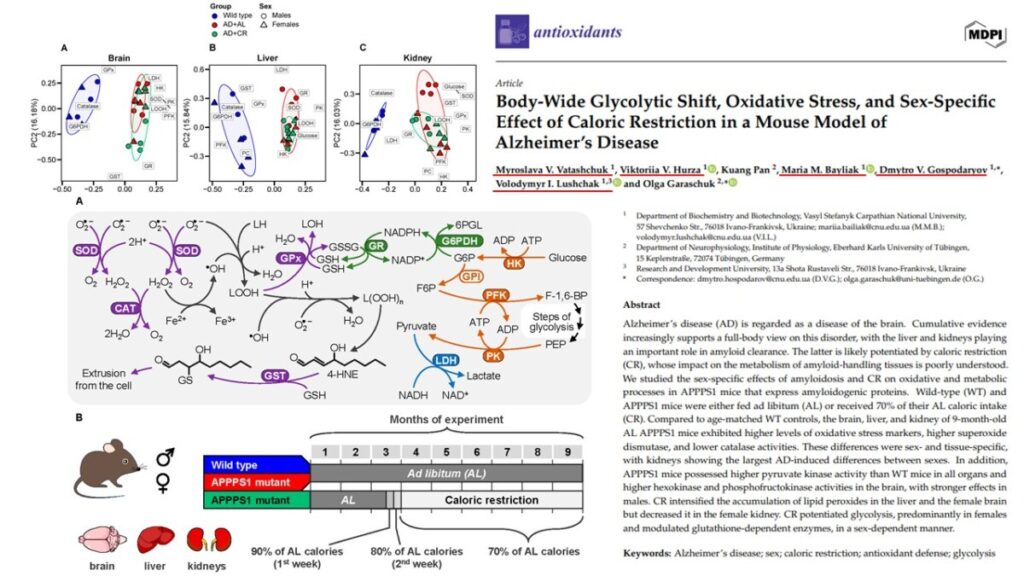
The Department warmly congratulates researchers Myroslava Vatashchuk and Viktoriia Hurza, Associate Professor Dmytro Gospodaryov, Professor Volodymyr Lushchak, and Head of Department Professor Maria Bayliak on the publication of the experimental article “Body-wide glycolytic shift, oxidative stress, and sex-specific effect of caloric restriction in a mouse model of Alzheimer’s disease” in the journal Antioxidants (impact factor 6.6, Q1 in Biochemistry, Clinical Biochemistry, Molecular Biology, Physiology, and Food Science). Other co-authors include Professor Olga Garaschuk, Head of the Department of Neurophysiology at the University of Tübingen (corresponding author), and postdoctoral researcher Kuang Pan.
This work, published in Antioxidants, represents the department’s first experimental study dedicated to neurodegenerative diseases. The research was carried out at the Institute of Physiology of the University of Tübingen as part of a long-term collaboration with Professor Olga Garaschuk. Visits of Myroslava and Viktoriia to the German laboratory were supported by the German Academic Exchange Service (project “Ukraine digital: Ensuring academic success in times of crisis 2024”, No. 57722940), while research materials were funded by the Volkswagen Foundation (grant No. 90233).
The study demonstrates that Alzheimer’s disease induces similar changes across several organs, including the brain, kidneys, and liver. Pyruvate kinase, a key glycolytic enzyme, showed elevated activity in all affected organs. Moreover, Alzheimer’s disease increased oxidative damage in the brain and liver. Caloric restriction, a well-known therapeutic strategy, was able to restore several parameters to control levels, though not uniformly across organs and in a sex-dependent manner.
Overall, the findings highlight the systemic nature of Alzheimer’s disease and emphasize the importance of considering not only the brain but also peripheral organs, as well as sex differences, when developing therapeutic strategies.
The full text of the article can be found at: